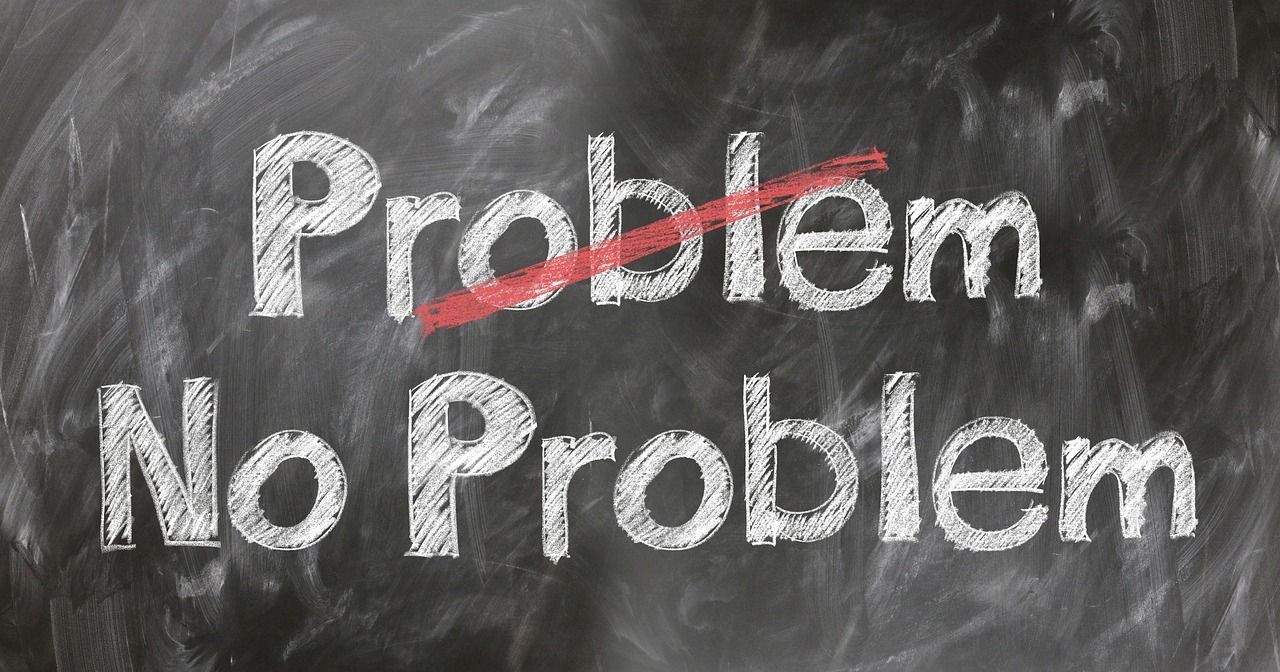
What is a problem?
Something happens – you miss a light and have to wait. Your boss criticizes your work. Your partner complains that you never pick up your socks. A tree falls onto your apartment or house.
What’s the problem? Is it the event, or the impact the event has on your reality?
The event only becomes a “problem” through the evaluation that happens in your head.
Evaluation Creates Problems
Stuff happens, it’s when you interpret how it impinges on your reality that it becomes a problem.
Therefore, problems exist inside you, not out in the world. Evaluation makes it a “problem,” not a blessing or a neutral thing.
That doesn’t mean that everything that happens is welcome or “good” or “fair” or “just.”
Just, fair, good, moral, right – those are all evaluations, based on a set of beliefs, not universal standards.
Once upon a time, it was widely considered right and just that women could not vote in America.
While most no longer hold those beliefs, some still see women voting as a “problem.”
Not a Problem?
Some things that are often labeled problems –
- Your AC/Heat breaks.
- You miss a deadline at work.
- You’re late to a client meeting.
- Insurance denies coverage of a hospital stay.
None of these things are very desirable. How much of a “problem” they are to you depends on your evaluation of them. Maybe you knew your AC was old and dying, and you saved up money to replace it. Then it’s a nuisance, perhaps, but not a crisis. If it happened with no warning when you’re barely paying bills, that may feel like “I don’t know how to deal with this.”
Ultimately, labeling something as a “problem” invites coping.
It externalizes the ownership of your actions. “They” have to “fix it.” Or “that’s how they are,” which means you don’t have to try to deal with it, because it’s too big for you.
If you’re Shaming yourself, it’s a way to accept that you have not taken ownership of being chronically tardy, because it’s easier beating yourself up for a little bit than facing the changes to being on time.
Obligation gives you an excuse to not do your best, because you “had to” do it to meet some imagined external standard.
All of this takes you away from owning what you have now and your choice to come.
Owning the Problem
Couples’ therapy has a concept of “The problem isn’t each other, it’s the two of you working to solve a problem outside of you.” It’s a useful way to remind partners to work together and not make each other into the enemy.
It also can take away ownership of what’s happening inside the brains of the partners.
The difference between someone who successfully solves a “problem” and someone who doesn’t is often rooted in being able to own it. If you’re coping, stuck believing that the problem lives “out there,” you’re stuck at effect not at cause and you’re waiting for things to happen to you.
When you own that things are how they are, regardless of how much you don’t like it, then you can focus your full power and choice on a solution that yields what you want.
You can still call it a “problem” if you like, as long as you’re clear that you own it.
If you’re still learning to challenge your beliefs that some things are just “too big” for you to solve, remember Epictetus:
“It’s not what happens to you but how you respond to it that matters.”
You can improve your ability to own what happens and to respond powerfully. The Responsibility Process® can teach you and support you.
You can do this. I can help.